
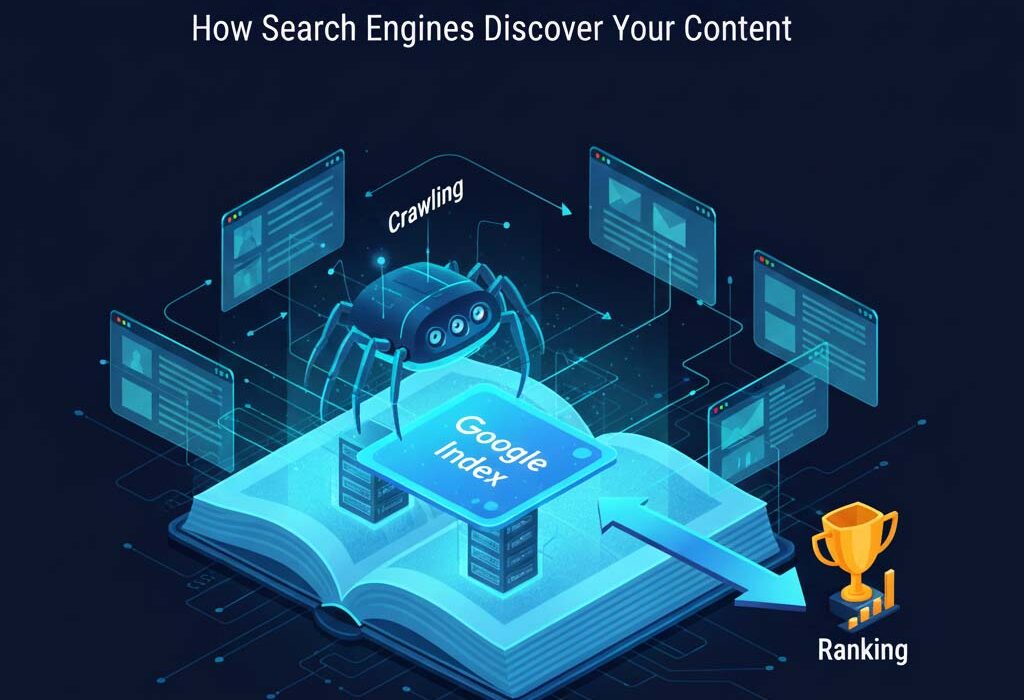
Introduction: The Invisible First Step to Online Success
Imagine you’ve just finished writing the most brilliant, helpful, and insightful blog post on the internet. You hit ‘Publish’ and lean back, waiting for the organic traffic to flood in. A week passes. Then a month. Crickets. What went wrong?
The simple, yet often misunderstood, answer lies in a single, critical concept: what is SEO indexing.
Indexing is the silent, crucial stage that happens before your page can ever appear on a Google search results page. Without proper search engine indexing, your fantastic content is essentially invisible, hidden away in the dark corners of the web. It’s like a book that has been written and printed, but hasn’t been placed on the library shelves yet – no one knows it exists.
This comprehensive guide is designed to pull back the curtain on this vital process. Whether you’re a complete beginner just launching your first WordPress website, a medium-level marketer trying to diagnose a drop in traffic, or an SEO expert looking for a refined technical overview, you’ll find actionable insights here. We’ll show you exactly how search engines work, why indexing is the absolute SEO foundation of your website, and, most importantly, what you need to do to ensure your hard work gets discovered.
By the time you finish reading this, you won’t just understand what is SEO indexing; you’ll have a clear, actionable roadmap to make sure your content is properly catalogued and ready to compete for those top rankings. To learn about what is SEO (Search Engine Optimisation) read our full guide on it.
What Exactly is SEO Indexing?
In the simplest terms, SEO indexing is the process by which a search engine, such as Google or Bing, analyses your web page, stores the information in its massive database (the Google index), and creates a searchable record of it.
Think of the entire internet as a colossal, ever-expanding library.
- Crawling is the process of the search engine sending out its digital librarians, known as web crawlers (or search engine bots like Googlebot), to systematically find and read every ‘book’ (web page) on the internet.
- Indexing is when those librarians read the book, understand its main topics, keywords, and overall value, and then catalogue all that information into the library’s master card file (the Google index). This is where the page is formally recorded and prepared for retrieval.
If your page isn’t in that master index, it simply cannot be retrieved when a user performs a search, no matter how perfectly that search matches your content. This is why search engine indexing is non-negotiable for visibility.
The Three Pillars of Search Engine Operation
To grasp the full importance of indexing, we must look at the three main phases every search engine goes through:
- Crawling (Discovery): The bot discovers the URL, usually by following links from an already-known page, or by finding it in an XML sitemap. It downloads the page’s HTML code, images, and other media.
- Indexing (Processing & Storing): The bot renders the page (executing JavaScript just like a browser would) and analyses all the content. It determines the page’s main theme, associated keywords, quality, and relationship to other pages. This processed data is then stored in the search engine’s index.
- Ranking (Serving Results): When a user types a query, the search engine instantly searches its index for all relevant pages. It then applies hundreds of complex ranking factors to order those pages, presenting the most relevant and authoritative results first.
The crucial takeaway? Indexing is the bridge between crawling and ranking. No indexing, no ranking.
The Journey of a Page: From Discovery to the Google Index
To truly be surprised by how fundamental this process is, you need to follow your content’s journey. It’s a sophisticated operation that involves constant, algorithmic decision-making.
1. Discovery: How Search Engines Find Your Content
A search engine can only index a page that it has first discovered. There are three primary ways a new URL enters the ecosystem:
- Following Links: This is the most common method. The web crawlers constantly move from page to page by following links (both internal and external). If your new post is linked from your homepage, a category page, or an established, authoritative external site, the bot will likely find it quickly. This is a great reason why you should focus on developing a strong internal linking system early on in your website’s life.
- XML Sitemaps: An XML sitemap is a file that lists all the important pages and files on your site for the search engine to read. It’s like leaving a detailed map for the web crawler. Submitting your sitemap via Google Search Console is the most reliable way to let the search engine know about all your pages, especially ‘orphan pages’ that might not be easily reached by following links.
- Manual Submission: For brand-new pages or pages that have been updated and need to be re-indexed quickly, tools like the URL Inspection tool in Google Search Console allow you to request a manual crawl.
2. Crawl Budget and Prioritisation
Did you know that search engines don’t have infinite time or resources to crawl every single page on the internet, every single day?
Every website is allocated a ‘Crawl Budget,’ which is an estimate of how many pages the search engine bots will crawl on your site within a given timeframe.
- For the beginner: If your site is new or small, your budget is likely generous enough. Just focus on the basics.
- For the medium/expert: If your site has thousands of pages, poor crawl budget allocation can mean your new, high-value content gets missed in favour of old, less-important pages.
Google prioritises crawling based on a few key factors:
- Page Authority: Pages with more high-quality backlinks and high-quality internal links are deemed more important and are crawled more frequently.
- Freshness: Pages that are updated frequently (like news sites or a bustling e-commerce store) are crawled more often.
- Quality: Pages that are perceived to offer high-value, original content are prioritised over low-quality, ‘thin,’ or duplicate pages.
To optimise your crawl budget, you need to ensure your sitemap is clean and that you use directives (like the noindex tag, which we’ll cover shortly) to exclude low-value or administrative pages.
3. The Indexing and Analysis Phase
Once the crawler has fetched the page, the real processing begins. This is where the magic of SEO indexing happens, and it’s far more complex than a simple keyword match.
The search engine’s indexing system performs several crucial tasks:
- Content Parsing: It reads and analyses the raw text, looking at the entire context, not just individual keywords. It identifies key phrases, entities (people, places, things), and the overall topic.
- Structural Analysis: It looks at your HTML structure, paying close attention to your SEO Title, Meta Description, and H1, H2, and H3 headings. These tags help the engine understand the hierarchy and main points of your content.
- Canonicalisation: If the search engine finds two or more pages with identical or very similar content (for example, a product page accessible via two different URLs), it has to choose a single ‘canonical’ or preferred version to include in the index. This prevents issues with duplicate content, which can dilute your ranking potential.
- Quality Assessment: The page is assessed against Google’s quality guidelines (E-E-A-T, or Experience, Expertise, Authoritativeness, and Trustworthiness) to determine if it’s worthy of being included in the main, high-quality index.
- Data Storage: Finally, all this analysed and organised information is stored in the Google index – a vast, distributed database ready to be matched against user queries.
This entire process, from crawl to index, can take anywhere from a few hours for an established, authoritative site to a few weeks for a brand-new one.
Indexability Issues: Why Good Content Gets Left Behind
The harsh truth is that not every page that is crawled gets indexed. Many excellent pages suffer from technical issues that block the final, crucial indexing step. Understanding these issues is key to mastering SEO indexing.
The Robots.txt File (The Gatekeeper)
Your robots.txt file sits at the root of your domain (e.g., yoursite.com/robots.txt). It’s a plain text file that tells search engine bots where they are allowed to go and where they are not allowed to go on your site.
- Beginner Tip: Think of it as a polite request to the crawlers.
- Expert Insight: A mistakenly placed
Disallow: /command can prevent the entire site from being crawled, thus blocking all search engine indexing.
While it controls crawling, it doesn’t strictly prevent indexing. A page disallowed in robots.txt can still sometimes be indexed if another authoritative site links directly to it. This is why you need the next step for definitive exclusion.
The ‘Noindex’ Tag (The Definitive Blocker)
If you absolutely do not want a page to appear in search results, the noindex meta tag is the definitive solution. This is a tag placed in the <head> section of your page’s HTML:
<meta name="robots" content="noindex">
Or, even more specifically for Google:
<meta name="googlebot" content="noindex">This tag tells the crawler, “You can visit this page, but do not store it in the Google index.”
Pages you should typically ‘noindex’:
- Thank You/Confirmation Pages: Pages a user sees after signing up or buying something.
- Internal Search Results: Pages generated when a user performs a search on your website.
- Low-Value Archive Pages: Tag, category, or author archives with very little unique content.
- Admin/Login Pages: You don’t want these public.
- Duplicate Content: The non-canonical versions of similar pages.
Other Common Indexing Obstacles
| Issue | Description | How It Harms Indexing |
| Thin or Low-Quality Content | Pages with minimal text, very little value, or content that appears to be automatically generated. | Search engines actively filter this out of the index to maintain quality. They will spend their crawl budget elsewhere. |
| Duplicate Content | Content that is identical or near-identical to another page on your site or another site. | Can confuse search engines, leading them to exclude one or all versions from the index. Canonical tags are the fix. |
| Broken Links (404/410) | Links pointing to pages that no longer exist. | Wastes crawl budget and signals poor site maintenance, potentially slowing down indexing of good pages. |
| Slow Page Speed | Pages that take a long time to load, especially on mobile devices. | The crawler may ‘time out’ or simply crawl fewer pages due to inefficiency, affecting your indexability. |
| No Internal Links | ‘Orphan pages’ that have no links pointing to them from other pages on your site. | Crawlers cannot find the page to begin the process of search engine indexing. |
Actionable Steps to Improve Your SEO Indexing
Now that you understand what is SEO indexing and the potential pitfalls, it’s time to get proactive. This section provides concrete, actionable steps for all experience levels to ensure maximum content visibility.
1. Start with Google Search Console (GSC)
Google Search Console is your direct line to Google’s indexing system. It is a free, indispensable tool.
- Submit Your XML Sitemap: Head to the ‘Sitemaps’ section and submit the URL of your sitemap (e.g.,
/sitemap_index.xmlif you use an SEO plugin like Rank Math or Yoast). This tells Google about all the pages you want to be indexed. - Monitor the Coverage Report: This report is a treasure trove of information. It tells you which pages are indexed, which are valid but not indexed (and why), and which pages have errors. You can find issues like pages excluded by
noindextags, pages marked as duplicates, or crawl anomalies. - Use the URL Inspection Tool: When you publish a new article, use this tool to quickly check its current status. If it’s new, you can click “Request Indexing” to encourage a fast crawl, ensuring your content is quickly added to the Google index.
2. Implement a Smart Internal Linking Strategy
A well-structured website is a crawlable website. Internal links are the pathways that guide the search engine bots to your new and important content.
- Link Deeply: Don’t just link to your homepage. Link from high-authority, established posts to your new, relevant content.
- Use Descriptive Anchor Text: The text you use for the link (the anchor text) helps the search engine understand the topic of the page you are linking to. For example, instead of “click here,” use a phrase like “learn how to use an SEO plugin to manage your indexability settings”. This reinforces your keywords naturally.
- Address Orphan Pages: Use the audit tools in your SEO plugin or GSC to identify any pages that have no internal links pointing to them. Add a link from a relevant, high-traffic page immediately.
3. Audit Your Indexing Directives
Mistakes in your robots.txt or noindex tags are the most common cause of major indexing failures.
- Regularly Check
robots.txt: Ensure you are not accidentally blocking any important sections. Use the robots.txt tester in GSC to double-check. - Verify
noindexUsage: Only use thenoindextag for pages you are certain you never want to appear in search results. Check your key content pages to ensure this tag hasn’t been added by mistake (which can sometimes happen with theme or plugin settings). - Implement Canonical Tags: If you have pages that are very similar (e.g., a printer-friendly version, or two product pages that only vary by colour), make sure you use the canonical tag to point the search engine to the one you want to rank. This ensures your link equity and ranking potential are consolidated on a single URL, boosting that page’s chances of successful search engine indexing.
4. Prioritise Content Quality and Technical Performance
Ultimately, the search engine only wants to index content that is useful to its users.
- Go Beyond ‘Thin’: Every page on your site should have a clear purpose and offer genuine value. If you have pages with fewer than 100-200 words, consider either expanding the content or adding a
noindextag. - Optimise for Mobile and Speed: Google’s index is primarily mobile-first. If your page is slow or looks poor on a phone, it negatively impacts your perceived quality and, thus, its chances of proper SEO indexing. For more information or reference on the importance of page experience, you can click here.
- Use Structured Data (Schema Markup): While not a direct indexing factor, using schema (like Article or FAQPage markup) helps the search engine understand your content more deeply. This clarity in classification can speed up the indexing process and potentially lead to rich results in the SERPs.
The Advanced View: Indexing and Ranking for the Expert
For those with a deeper understanding of SEO, the relationship between SEO indexing and ranking is where the strategy becomes truly nuanced. It’s not just about getting indexed; it’s about ensuring the right version of your page is indexed and that you are efficiently managing your crawl resources.
Understanding the Inverted Index
To understand why search results are so fast, it helps to know how the index is actually structured. Google uses an inverted index.
Instead of storing data by URL (Page A has these keywords, Page B has those keywords), it stores data by keyword (This keyword is on Page A, Page C, and Page X, at these locations on the page).
- The system: When you search for “best coffee machine,” the search engine doesn’t scan millions of pages. It goes directly to the “coffee machine” entry in the inverted index, pulls out a list of all relevant pages, and then applies the ranking algorithms.
- Your takeaway: This reinforces the need for semantic relevance. Your content must clearly, contextually, and consistently cover your topic so the indexing system can correctly and strongly associate your page with your target keywords.
The Power of Freshness and Re-indexing
For established websites, managing the re-indexing of important pages is a critical task.
- The Freshness Factor: Content that is up-to-date and recently revised is given priority. If you make a significant update to a high-value page, use the URL Inspection Tool in GSC to ‘Request Indexing’ for that specific URL. This signals to Google that the page has changed and requires a fast review.
- Disaster Recovery: If you fix a significant technical issue (like removing a site-wide
noindextag that was placed by mistake) and you see a massive drop in indexed pages, you can use the ‘Validate Fix’ feature in GSC’s Coverage report. This prompts Google to recrawl and re-index the affected pages.
Indexing and Core Web Vitals
The quality of the page experience, which is heavily influenced by Google’s Core Web Vitals (Largest Contentful Paint, First Input Delay, and Cumulative Layout Shift), plays a role in both ranking and indexability. A poor page experience can signal a lower-quality page overall, meaning Google might decide to crawl and index it less frequently.
Ensuring a fast, smooth, and mobile-friendly user experience is no longer just a ranking factor; it’s an SEO foundation that supports your entire indexing strategy.
Conclusion: Make Indexing Your First SEO Priority
We’ve covered the full journey, from the moment a web crawler discovers a URL to when that page is successfully stored in the vast Google index, ready to compete for a top spot. The complexity of what is SEO indexing should be surprising in its sophistication, yet the steps to ensure success are straightforward and entirely within your control.
Your most brilliant, informative content is worthless to your business if it remains invisible. By consistently focusing on:
- Building a robust internal linking system.
- Submitting a clean XML sitemap.
- Vigilantly monitoring your indexability in Google Search Console.
- Maintaining a high standard of content quality and technical performance.
You ensure that your pages move quickly and efficiently through the ‘crawl, index, rank’ cycle. Mastering search engine indexing is not just a technical chore; it is the fundamental, most important step you can take to guarantee your content achieves the online visibility it deserves.
Now go check your coverage report. Your rankings depend on it!